


It wasn’t all that long ago that Italy was the punchline of every joke about European politics.
The country’s governments came and went. The debt never seemed to go away. Skyrocketing youth unemployment pushed an entire generation to look for opportunities abroad, while Rome developed a reputation for being unable to get much done.
The Eurozone crisis in 2009 only made things worse. Banks were under pressure, economic growth was stagnant, and Brussels seemed to be watching Italy with equal parts concern and frustration.
Italy’s political divisions ran just as deep. Immigration became increasingly hot-button, only fueling the divide between north and south. And after years of out-of-touch technocratic governments, with constantly shifting coalitions, many Italians were simply tired of the politics as usual that seemed to produce more instability than results.
To many, including the outside world, Italy appeared stuck. Now, that picture is changing.
First, a dose of reality: Italy is not suddenly an economic powerhouse, and many of its old institutional problems remain; however, the country has regained a degree of political and economic credibility that seemed impossible to imagine a decade ago.
Unemployment has fallen to levels Italy has not seen in years, borrowing costs have eased, and the government deficit has reduced significantly. Furthering this transformation is Italy’s rise as an assertive player within the European Union, where it’s become increasingly active on issues such as migration and energy, as well as strengthening relations with Africa.
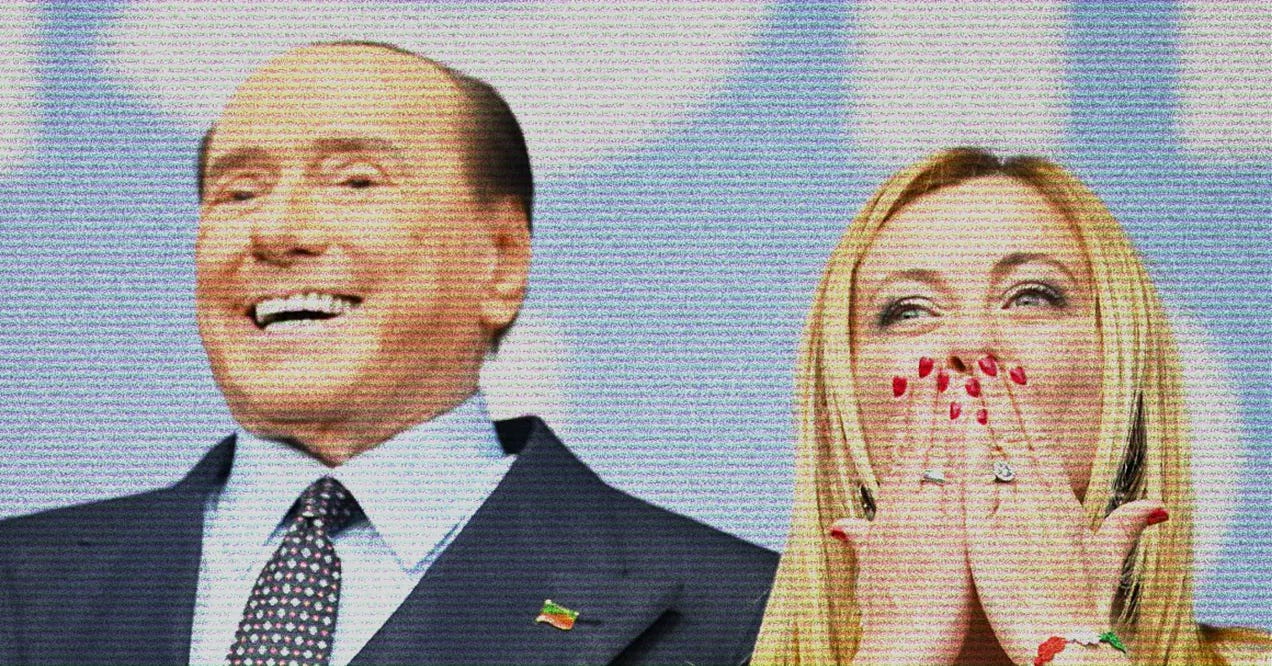
But this transformation didn’t begin with Giorgia Meloni. In many ways, Silvio Berlusconi helped lay the groundwork.
Berlusconi changed Italian politics after the collapse of the old party system in the early 1990s. He demonstrated that a center-right coalition could win nationally and govern for an extended period. He introduced a very different style of communication into politics never before seen at the time, one built around television, personality, and popular culture rather than the traditional language of Italian party politics.
Admittedly, his governments were hardly models of stability. They were often chaotic, and Berlusconi’s legal and personal controversies frequently became distractions. But his importance to Italy’s right is difficult to overstate. He helped normalize the idea that Italy could be governed from the center-right without the country immediately descending into crisis.
When the sovereign debt crisis eventually forced Berlusconi from office in 2011, the political realignment he had helped create didn’t disappear. It simply needed someone else to carry the torch.
That person was Meloni.
Her Brothers of Italy party (Fratelli d’Italia) had spent years on the political sidelines. It emerged from the post-fascist fringe of the Italian right and, for a long time, was a relatively small force in Italian politics. Meloni stuck with it while other parties took turns governing, compromising, and eventually disappointing voters.
But by 2022, the political environment was ripe for change. The traditional parties were exhausted, the Five Star Movement - Italy’s first major anti-establishment party in the digital age - had lost much of its momentum, and the country had just come through the technocratic government of Mario Draghi.
Meloni offered something different: a clear ideological identity combined with a promise to actually govern.
She became Italy’s first female Prime Minister after her coalition of Brothers of Italy, Matteo Salvini’s Lega, and Berlusconi’s Forza Italia won the 2022 election.
And just last week, Meloni’s government officially became the longest-serving government in Italy’s postwar history, surpassing Berlusconi’s previous record. That is a particularly significant achievement in a country that has had 68 governments and 31 prime ministers since the republic was established in 1946.
Longevity alone does not make a government successful; however, in Italy, longevity is meaningful because political instability has been such a defining feature of the country’s postwar history.
So why has Meloni managed to endure?
Part of it is that she has been more disciplined than many people expected.
Meloni took a party with extremely complicated historical baggage and moved it toward a broader form of national conservatism centered on immigration, family policy, national sovereignty, and Italian interests. She has also managed to keep her coalition together despite the very real differences between Brothers of Italy, Lega, and Forza Italia.
But also, just as importantly, she has shown a willingness to be pragmatic in government.
The Meloni who campaigns in front of a partisan crowd can sound very different from the Meloni sitting across the table from European leaders or international investors. That flexibility has allowed her government to maintain relationships with Brussels and Italy’s European partners while still presenting itself at home as a nationalist alternative to the political establishment.
While the country’s economic picture remains more complicated than some might suggest, there are genuine improvements worth recognizing.
Italian unemployment has declined, and the European Commission expects the government’s deficit to fall from 3.1% of GDP to 2.9% by the end of this year.
This doesn’t mean Meloni’s government has solved every problem, but it does mean that, for once, Italy finally looks like a country that is not constantly on the verge of making its problems worse.
That distinction matters more than some might realize.
Still though, the country’s economic growth is weak. Its debt burden has shrunk but remains enormous. The South continues to lag behind the North. Real wages and purchasing power are among the concerns discussed nightly at the kitchen table. The country’s demographic situation is particularly serious, and its population is projected to shrink substantially over the coming decades, creating yet another challenge for its workforce and welfare system.
Meloni has also benefited from circumstances that sometimes had little to do with her personally, however. European Union recovery funds gave Italy additional support following the pandemic, and energy prices, migration, and geopolitical tensions created political openings for a government willing to emphasize national security and economic stability.
For instance, her government pursued the controversial Mattei Plan for Africa - which opponents on the left view as modern neocolonialism that prioritizes European energy needs over African development - and has positioned Italy as a more prominent player in the Mediterranean, particularly on energy, migration, and trade.
Speaking of immigration, it remains one of the most politically important issues within Italy. Meloni campaigned heavily on reducing irregular migration, and her government took steps to adopt tougher asylum and anti-smuggling measures. Arrivals have fallen substantially from some of the peaks seen earlier in the decade, yet migration pressures have certainly not disappeared.
But, despite all of this, there is a broader change that is even harder to measure.
For decades, Italian politics often seemed to be about surviving until the next government rather than building something that would last beyond it. That mentality has not disappeared, but Meloni’s tenure has disrupted it.
Berlusconi showed that the Italian right could win and build a durable political coalition.
Meloni has shown that it can stay in power without the constant political drama that once seemed almost inevitable.
Again, that doesn’t mean Italy has solved all of its problems.
But Italy today is different from the Italy that struggled through the Eurozone crisis a decade ago. It has more political stability and a government that has established itself as a serious player in Europe and on the world stage rather than a perpetual source of anxiety for Brussels and financial markets.
Whether that becomes a lasting political realignment or simply another period of calm before Italy’s next political storm remains to be seen.
For now, though, Italy no longer looks like a country waiting for someone else to rescue it, and, at least to some extent, it has found its footing again.
That’s no small achievement in a Europe still wrestling with its own instabilities.