


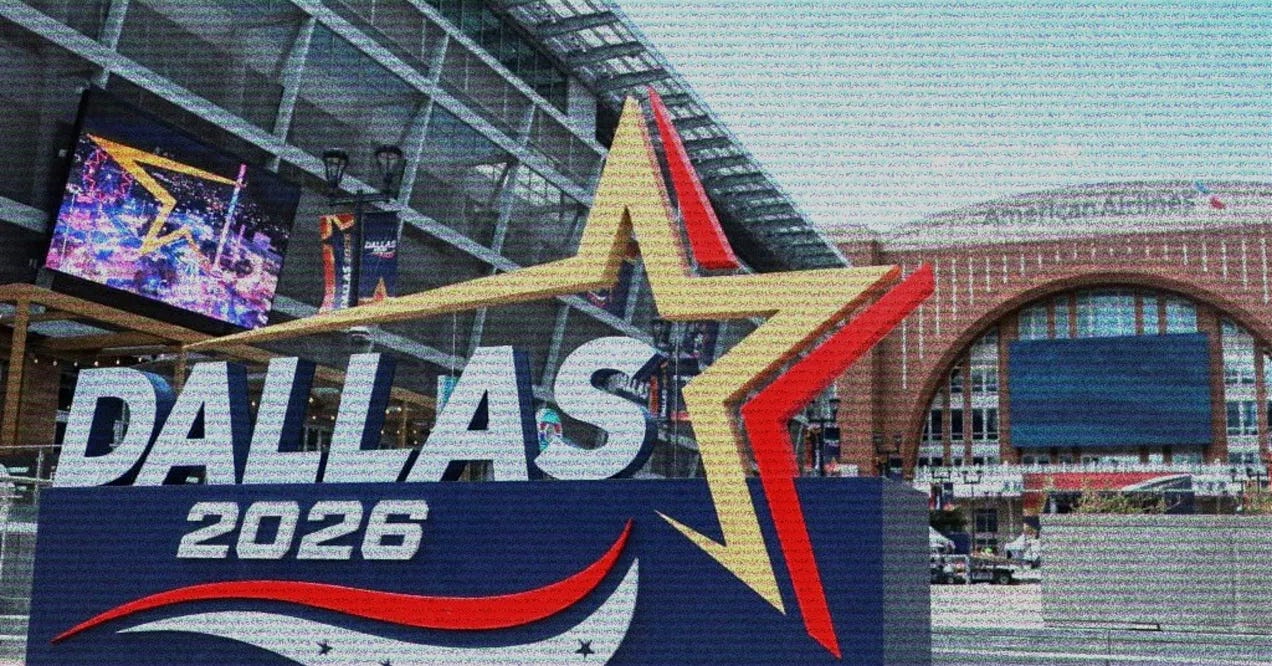
As Republicans gather in Dallas for tonight’s kickoff to the first midterm convention in the party’s 172-year history, it’s a show that’ll be hard to miss.
Two nights at the American Airlines Center, more than four dozen speakers, and appearances by President Donald Trump both nights. Vice President JD Vance will deliver a keynote, alongside top Cabinet officials, governors, senators, House members, and candidates running in some of the country’s most competitive races.
And, as at previous conventions, pastors, border agents, factory workers, and ordinary Americans will speak in support of the party’s policy achievements.
The symbolism is obvious. But the question I’ve been asking is what Republicans will actually do with the stage.
A few weeks ago, in Average American News, I argued that Dallas would only matter if Republicans used the opportunity to talk about the issues voters are actually thinking about, particularly the economy and the cost of living, instead of two nights litigating the political battles that energized the base for years.
A recent Pew Research Center poll painted that picture pretty vividly. When registered voters were asked what they most wanted congressional candidates to talk about, economic issues came out on top. Cost of living and affordability alone accounted for 15% of responses, while the broader category of economic issues reached 29%
And the underlying economic mood is still pretty sour. Only 24% of Americans rated economic conditions as excellent or good. Healthcare, housing, and energy remain major concerns, while concern over gasoline prices jumped significantly from earlier in the year.
So what does the Republican convention look like through that lens? I’d say pretty deliberate.
Republican Midterm Convention: Night One
Tonight, September 9th, opens with “Working Families Tax Relief.”
That is no accident.
The first programming block begins at 4pm ET and is built around the Working Families Tax Cuts Act, the permanently doubled standard deduction, Trump Accounts, and an expanded Child Tax Credit. It also moves into housing assistance, including the Trump administration’s efforts to address improper payments and fraud, as well as healthcare affordability and the $50 billion Rural Health Transformation Program.
From there, Republicans can establish the broader contrast they want voters to see: two different approaches to governing.
Tax policy is at the center. Election integrity and public safety are part of the program, but they are woven into a larger discussion about border security, criminal offenders, and government accountability rather than being allowed to consume the entire evening.
Throughout the night, the candidates’ showcases follow the same basic formula.
There is “No Tax on Tips.” There is the enhanced Child Tax Credit. There are speeches about immigration enforcement, manufacturing, trade, and the reshoring of American jobs. School choice and parental rights get their own block, as do healthcare fraud, public safety, and policies that Republicans claim have driven economic expansion through lower taxes and lower costs.
There’s even a programming block about banning members of Congress from trading individual stocks.
The lineup itself tells you something about what the party wants this convention to be. Republican Chairman Joe Gruters, House Majority Leader Steve Scalise, Majority Whip Tom Emmer, Senators Tim Scott and John Barrasso, HUD Secretary Scott Turner, CMS Administrator Mehmet Oz, Treasury Secretary Scott Bessent, and Florida gubernatorial nominee Byron Donalds are among those taking the stage on night one.
Clearly, this is not just a rally.
It’s an attempt to present an argument about Republican governance.
Republican Midterm Convention: Night Two
Tomorrow night, September 10th, sticks with a similar theme.
The night begins at 4pm ET with speeches from American families who’ve benefited from changes involving tips, overtime, and Social Security. From there, the programming moves through government accountability and congressional stock trading again, education, hostage recovery, small business growth, food security, and public health.
According to the Republican National Committee’s official schedule, there will also be a tribute to Charlie Kirk and a 9/11 remembrance featuring children and families of first responders.
Later in the night, prescription drug costs get their own focus, including TrumpRx and Most-Favored Nation agreements. The “Make America Healthy Again” agenda gets a segment of its own too, with an emphasis on chronic disease.
And, once again, the final stretch returns to the economy: trade, American energy production, and direct tax relief.
As expected, Texas Republicans will be playing a major role. Lieutenant Governor Dan Patrick, Senator Ted Cruz, and Governor Greg Abbott will all be part of the program, along with other Texas candidates and elected officials.
The administration’s presence is just as significant on night two, with HHS Secretary Robert F. Kennedy Jr., former White House Press Secretary Karoline Leavitt, and Donald Trump Jr. among the speakers.
Then, Vance and Trump will close it all out.
This is the frame Republicans want, and the most notable thing may actually be what it does not do.
This is not a convention built primarily around settling old scores or litigating past elections, even if those subjects remain part of the broader Republican political conversation.
Instead, Republicans are putting taxes, healthcare, housing, manufacturing, drug prices, immigration enforcement, and the cost of living front and center of the program.
That makes sense given where voters are right now. That Pew survey I mentioned earlier showed that neither party held a clear advantage when voters were asked which party they agreed with more on economic policy: 37% chose Democrats, and 36% chose Republicans.
That last part is important.
Republicans cannot simply tell voters that the economy is doing well and expect the argument to end there. Lived experiences ignore talking points.
If the party wants credit for its economic agenda, it has to explain what actually changed.
What did the tax cuts mean for a family making $60,000 a year?
How are tariffs affecting prices?
Are the administration’s energy policies actually lowering costs?
Are prescription drug prices really becoming cheaper?
What does “reshoring” mean for a worker who has not seen a meaningful increase in their paycheck?
Those are the questions that ultimately matter.
And that same principle very much applies to foreign policy.
The ongoing conflict with Iran makes the economic argument even more complicated. Republicans can argue that American strength and a clear foreign policy doctrine serve a larger strategic purpose, but voters are still going to notice what happens to the price of gas and groceries.
Pretending there is no tradeoff is unlikely to be persuasive - but Dallas is a chance for Republicans to make the argument on their own terms.
There is another reason this convention matters, however.
Putting dozens of people on stage in a packed arena is easy compared to getting voters to believe that a political party is actually making their lives better.
That’s the real challenge.
Midterm elections have historically been difficult for the party in power. Turnout is always projected to be low as enthusiasm fades. Voters often use the election as an opportunity to express their frustration with the party occupying the White House.
And still, Republicans have another problem: the coalition that gave them their 2024 mandate cannot be taken for granted.
Pew’s July survey also found that Democrats were more engaged with the midterm election, with 39% saying they had thought a lot about congressional elections compared with just 22% of Republicans.
That doesn’t mean the outcome is predetermined, but it does mean that Republicans have more work to do.
This convention gives Republicans a national audience for two nights, with nearly every major figure in the party featured to make the case for what they have done and what they intend to do next.
They are choosing to put affordability and economic issues at the center of that argument.
That is a conscious choice.
Whether voters believe the claims, whether the policies have produced the results they can actually feel, and whether that message reaches beyond the Republican base will be determined long after the lights go down at the American Airlines Center.
I previously said that Dallas won’t decide the midterms. It won’t
But it can help determine what Republicans are talking about when they soon enter the final stretch of their campaign.
The good news, at least, is that the party appears to understand that the most important political conversation is not happening on cable news or inside the beltway.
It’s happening at the kitchen table.