


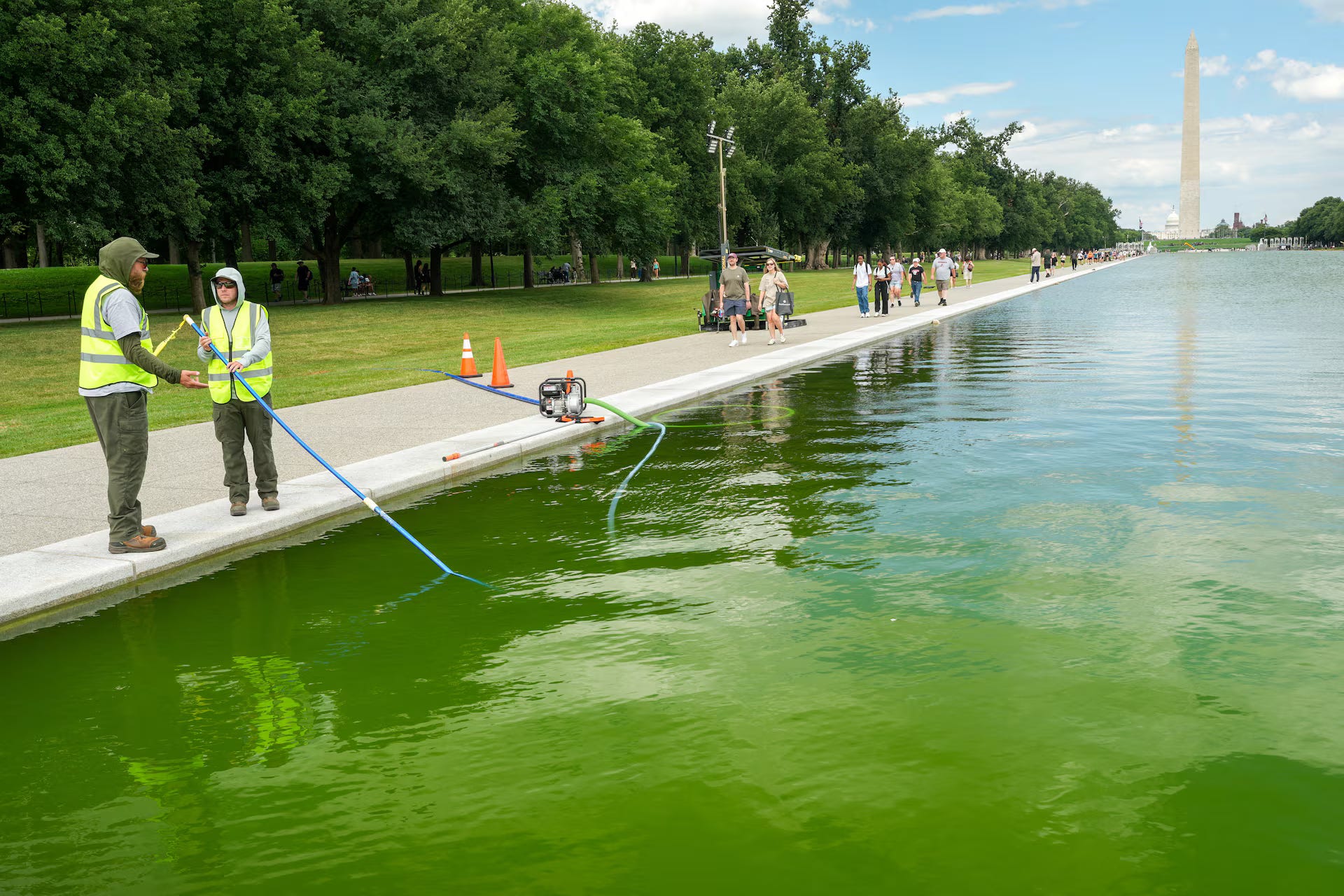
There are few images more synonymous with Washington, D.C. than the long, glassy stretch of water running between the Lincoln Memorial and the Washington Monument. For decades, the Reflecting Pool has served as a backdrop for protests, presidential inaugurations, postcard photography, and the occasional viral tourist video. This summer, it’s gone viral again — but not for the reason anyone in the Trump administration was hoping for.
Just weeks after the completion of a multimillion-dollar renovation personally championed by President Donald Trump, the freshly painted bottom of the Reflecting Pool has begun peeling away in sheets, floating to the surface, and tangling with one of the largest algae blooms the site has seen in years. What was supposed to be a crisp, “American flag blue” showcase ahead of the country’s 250th birthday has instead turned into a swampy, discolored mess that’s drawing scrutiny from journalists, park visitors, and government watchdogs alike.
Why It’s Suddenly in the News
The Reflecting Pool has always been a maintenance headache. The iconic pool has struggled with algae and leaks for decades despite multiple renovations. But this latest controversy traces back to a renovation effort pushed by Trump as part of a broader beautification campaign tied to the nation’s upcoming semiquincentennial celebrations.
According to Newsweek, the $14 million refurbishment was completed earlier this month and was intended to transform the landmark ahead of the 250th anniversary festivities. The work was handled by a Virginia-based firm, Atlantic Industrial Coatings, brought in for the high-profile overhaul of the century-old basin.
Almost immediately after the pool was refilled, things started going sideways. Algae turned large portions of the water a murky green, and crews scrambled to treat it. Then came the second blow: video and photos circulating online showed large flaps of the newly applied blue coating tearing loose from the floor of the pool and bobbing to the surface, sometimes in chunks large enough to be spotted from the walking paths above.
CNN observed a flap of blue material partially attached to the bottom in one area of the pool, floating toward the top, and reported it remains unclear whether the material is paint or sealant, or what caused it to lift in the first place. The Interior Department, which oversees the site, did not have an immediate explanation when reporters asked.
By the time the Washington Post checked in on the situation, an “American Flag Blue” paint sheet was photographed floating on the surface as crews worked to clear out the algae a second time.
The Money: From $1.8 Million to Nearly $15 Million
Perhaps the most galling part of the story for taxpayers is just how far the project’s price tag drifted from its original estimate. The renovations were initially estimated to cost $1.8 million, but the project’s cost has climbed to roughly $14.7 million based on a contract summary of the Interior Department’s award.
That’s nearly an eightfold increase over the original budget — and it came without the standard competitive process typically required for major federal contracts. Multiple outlets reported that the renovation bypassed the required bidding process and the contract was instead awarded to a company without prior federal contracting experience. The New Republic similarly noted that the president personally requested the “American flag blue” paint color for the renovation, and the contract skipped competitive bidding in favor of an inexperienced contractor.
For a National Mall visitor interviewed by WTOP News while inspecting a section of peeling coating, the math simply didn’t add up. One tourist from Columbus, Ohio, summed up the frustration that’s been echoing across social media and comment sections all week — essentially that for the kind of money being spent, taxpayers expect to see quality workmanship, not a pool falling apart within days of being finished.
The Algae Problem Nobody Solved
Algae blooms aren’t new to the Reflecting Pool. The basin has wrestled with the issue for generations, partly because of its source water and partly because of its sheer size. As The Mirror pointed out, the pool is larger than ten Olympic-sized swimming pools, a scale Trump himself has likened to a lake, and its water draws from the often murky Tidal Basin.
This time, however, the bloom arrived almost immediately after the renovation was finished and the pool was refilled — undercutting the central promise of the project, which was to finally put the algae issue to rest. Algae has long been a recurring issue at the site, but the entire purpose of this renovation was supposed to be cleaning it up for good. Instead, within days of refilling the pool, the algae problem resurfaced in force.
The Trump administration’s response has involved a combination of old-fashioned manual labor and more experimental tactics. Workers have been seen pouring large quantities of hydrogen peroxide into the water and wading out to filter it by hand, while officials have also pointed to use of a “nanobubbler” device as part of the treatment plan. Interior Department officials initially blamed residual algae trapped in the supply pipes for the outbreak, rather than any flaw in the renovation itself.
There was also a public-relations misstep along the way. The Interior Department claimed on a Wednesday that the algae problem had been resolved, sharing a photo that critics said was misleading because it captured blue sky reflecting off the water rather than genuinely clear, blue-tinted water below the surface.
When the Cure Became Part of the Problem
If the algae bloom wasn’t bad enough, reporting now suggests the very treatment used to fight it may be responsible for the paint peeling off the pool floor. According to the New Republic and Yahoo News, the hydrogen peroxide treatments haven’t just failed to clear the algae — they’ve also caused the blue paint to peel and pushed phosphate levels in the water to levels far above what’s recommended for keeping algae blooms in check, according to independent water testing CNN conducted with help from a swimming pool store.
In other words, the chemical fix deployed to address one embarrassing problem may be actively fueling a second one, in something of a feedback loop: more chemicals to fight algae, more peeling paint, and potentially more phosphates feeding future algae growth.
Not the First Time — and Probably Not the Last
It’s worth noting this isn’t the Reflecting Pool’s first expensive do-over. Back in 2012, the Obama administration spent $34 million on an 18-month renovation specifically meant to address the pool’s chronic algae problems — and the algae returned shortly after that project wrapped up as well.
That history adds an extra layer of irony to the current situation. The pool has now been the subject of two extremely costly renovations within roughly a decade and a half, both explicitly designed to solve the same recurring algae issue, and both apparently falling short within a short window of completion.
A Very Public Embarrassment
Because of its location and visibility, the Reflecting Pool isn’t just any piece of federal infrastructure — it’s one of the most photographed places in the country. Sitting along the axis between the Lincoln Memorial and the Washington Monument, the pool is among the most photographed sites in Washington, which has only amplified public attention on any visible changes to it.
That visibility has turned a contracting and maintenance dispute into a viral news story, complete with widely shared videos of paint sheets rippling up from the pool floor. The combination of the early maintenance problems and the project’s hefty price tag has intensified criticism from observers who say the renovation reflects a rushed, poorly executed use of taxpayer money on a highly visible public project.
Social media commentary has not been kind, either, with online critics needling the administration over the timing — the failures becoming public knowledge right around the Fourth of July season, just as the pool was meant to be unveiled as a showpiece ahead of America’s upcoming 250th anniversary celebrations.
What Happens Next
As of this week, the Interior Department has not laid out a clear public timeline for permanently resolving either the algae bloom or the peeling coating. Crews continue to dredge sections of the pool and apply chemical treatments, while loose flaps of blue material continue to surface in scattered areas of the basin.
For now, the Reflecting Pool remains a visible, ongoing reminder of how a high-profile, fast-tracked infrastructure project can go wrong when speed and optics take priority over a competitive bidding process and rigorous testing of materials. Whether the administration moves to recoup costs from the contractor, orders a second contractor to fix the peeling, or simply waits out the algae cycle as has happened in renovations past, remains to be seen.
What’s clear is that for a basin meant to symbolize calm, order, and reflection at the heart of the National Mall, the last few weeks have offered the opposite: chaos, green water, and a multimillion-dollar paint job quite literally coming apart at the seams.