


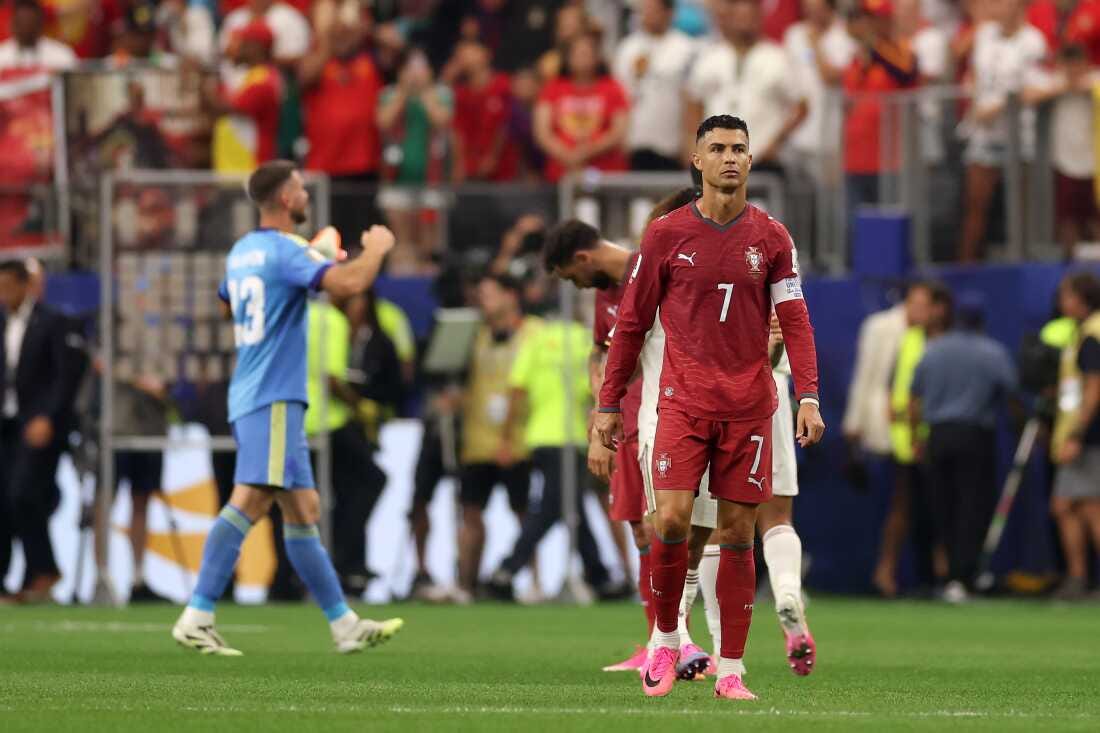
Let’s start with the part that sounds made up but isn’t: the President of the United States picked up the phone, called the head of FIFA, and a few days later a red card that should have kept America’s best player out of a World Cup knockout match just... disappeared. Not overturned, exactly. Suspended. Paused. Whatever word you want to use, Folarin Balogun walked onto the pitch against Belgium on Monday night, and he only did that because Donald Trump made a call that, by his own account, he never should have needed to make.
If you missed it, here’s the short version, and then we’re going to slow down and actually pick this thing apart, because there’s a lot more going on here than “Trump helped his guy get back on the field.”
What Actually Happened
Balogun, the USMNT’s leading scorer in the tournament with three goals, went into a challenge against Bosnia and Herzegovina’s Tarik Muharemovic and stepped on his ankle. VAR got involved, and referee Raphael Claus of Brazil sent him off in the 64th minute. <cite index=”1-1”>The U.S. still managed to win that match 2-0, but the red card triggered an automatic one-game suspension</cite>, which would have knocked Balogun out of the Round of 16 clash with Belgium — arguably the biggest game of the tournament for this team.
That’s a rough break for any team, but especially for one that, as multiple outlets have pointed out, <cite index=”9-1”>hasn’t advanced past the Round of 16 since beating Mexico back in 2002</cite>. So the stakes weren’t small. This wasn’t a group-stage dead rubber. This was do-or-die soccer, and the Americans were about to do it without their best forward.
Here’s where it gets interesting. According to reporting from Politico, picked up by Yahoo Sports, <cite index=”5-1”>Andrew Giuliani — who runs the White House’s World Cup task force — looped in Trump about the situation, and from there Giuliani, Commerce Secretary Howard Lutnick, and U.S. Soccer officials started building a plan to challenge the suspension</cite>. Trump reportedly called FIFA president Gianni Infantino directly on Thursday. Around the same time, U.S. Soccer’s legal team filed a formal appeal through the actual process that’s supposed to handle these things.
And then, on Sunday, FIFA announced it was suspending the ban. Balogun was free to play.
The White House Line vs. FIFA’s Line
Now, how you feel about this probably depends on which explanation you believe, and both sides have given one.
Trump’s version, delivered from the Oval Office on Monday, is pretty simple: he thought the call was wrong, and he said so. <cite index=”9-1”>”Yes, I asked for a review by FIFA,” he told reporters, adding, “It’s one thing to penalize somebody for the game, but how do you penalize them for a game that hasn’t been played yet? It’s very unfair, you can’t do that.”</cite> He went further, arguing the original contact wasn’t a foul at all — just <cite index=”7-1”>two players running full speed who happened to collide</cite> — and took a shot at the referee, calling him <cite index=”7-1”>”very suspect.”</cite> He also made sure to note he didn’t order anyone around, just made a request: <cite index=”1-1”>”All I did was ask for a review. I didn’t say, you have to do this.”</cite>
Infantino’s version is designed to thread a needle. He confirmed the call happened — didn’t try to hide it — but insisted it had zero bearing on the outcome. <cite index=”6-1”>He put out a statement defending FIFA’s decision to reverse the red card</cite>, and in it he leaned hard on the idea of institutional independence. <cite index=”8-1”>He said that during the call, he explained there was an ongoing legal process handled by FIFA’s independent judicial bodies, and that the case would be decided in due course by the competent bodies — “that is how FIFA’s system works, and it is a principle that I will always uphold.”</cite> He also made the point, probably to normalize the whole thing, that <cite index=”8-1”>he regularly talks with the U.S. president about World Cup matters, just like he talks to plenty of heads of state, government officials, and business executives around the world</cite>.
A U.S. official told ABC News essentially the same story from the other side of the phone: <cite index=”1-1”>Trump wanted to understand why the red card and suspension happened, was told the appeal process runs through an independent board, and the U.S. government simply provided additional evidence that was used in that appeal — with the official calling the eventual outcome “correct and proper.”</cite>
So take your pick. Either a president made a phone call, asked a reasonable question, and a separate legal process happened to land in his favor. Or a president leaned on the head of a global sports organization and got the result he wanted within about 72 hours. Both of those stories were told by the people involved. Neither one requires you to believe the other is lying, exactly — but it’s a lot of coincidence to swallow if you’re on the skeptical side.
What FIFA Actually Cited
It’s worth knowing the mechanism FIFA used here, because it’s not nothing — it’s a real rule. FIFA pointed to Article 27 of its Disciplinary Code, <cite index=”9-1”>which states that a judicial body “may decide to fully or partially suspend the implementation of a disciplinary measure.”</cite> FIFA also put out a statement stressing that <cite index=”1-1”>there’s nothing in the Disciplinary Code or the World Cup 26 regulations that stops the Disciplinary Committee from using that discretion</cite>. On top of the suspended ban, <cite index=”8-1”>FIFA fined the U.S. Soccer Federation $40,000</cite>, which was presumably meant to signal that they weren’t letting Balogun completely off the hook.
Here’s the thing though — and this is where the “it’s nothing new” defense starts to wobble a little. <cite index=”8-1”>FIFA itself said reviewing the legal consequences of red cards isn’t new in the modern game, and that suspending the effects of a card under an explicit regulation is actually a “more balanced” measure than letting the ban stand</cite>. That’s a fair technical point. But Time’s reporting flags something important: <cite index=”9-1”>suspending a disciplinary measure like this is extremely rare for FIFA</cite>. They cite one comparable case — Cristiano Ronaldo in 2025, who got a three-game ban for a red card and had two of those games suspended. So this tool exists, and it’s been used before. It’s just almost never been used, which is exactly why people are raising eyebrows now that it happened to land on the American team’s star player right after a presidential phone call.
There’s also a procedural wrinkle that’s easy to miss. <cite index=”9-1”>While national federations typically handle disciplinary matters with FIFA, there’s no public evidence that a formal request to suspend Balogun’s automatic ban was even submitted before Trump got involved</cite>. In other words, the normal channel for this kind of relief may not have been activated until after the president picked up the phone. That’s the detail that turns this from “the President asked a question” into “the President may have started the process that got the result.”
The Backlash Was Immediate and Loud
Whatever you think about the merits of the call itself, the reaction tells you this crossed a line for a lot of people in the sport. <cite index=”7-1”>Former FIFA president Sepp Blatter — no stranger to controversy himself — put it bluntly: “Red cards are not overturned by political phone calls. They are overturned by rules, evidence and independent bodies.”</cite> He went further, framing it as a slippery-slope question for the institution itself, essentially asking what happens the next time a head of state doesn’t like a call.
Coaches were just as pointed. <cite index=”7-1”>Norway’s Ståle Solbakken asked what happens with the next red card, calling the whole situation a “bad, bad, bad, bad, bad decision” that would hurt the tournament</cite>. England manager Thomas Tuchel raised a version of the same worry — <cite index=”7-1”>wondering aloud whether other decisions could now be challenged</cite>, name-checking yellow cards for his own player and a French opponent as examples. Legendary former England striker Wayne Rooney called the reversal <cite index=”2-1”>”an absolute disgrace,”</cite> saying he’d be furious if he were facing the U.S. and that the sportsmanship of the tournament itself was now in question.
Even Argentina’s Mauricio Pochettino — who presumably didn’t want to wade into American politics on a soccer beat — tried to keep some distance from it, telling reporters, <cite index=”9-1”>”No, we cannot mix that. We cannot mix that,”</cite> when asked whether Trump’s involvement affected the outcome.
And this being 2026, the reaction split along predictable political lines almost instantly. <cite index=”2-1”>Critics framed the whole episode as an accountability problem for FIFA, while defenders of the decision argued the original red card was bad in the first place and that international critics were reflexively anti-Trump</cite>. Writer Julia Ioffe found a pretty sharp irony in the situation, pointing out that <cite index=”2-1”>Trump was fighting to keep a player on the field who only qualifies for the national team through birthright citizenship — the same policy Trump has been trying to dismantle</cite>. That’s the kind of detail that doesn’t fit neatly into either side’s talking points, which is usually a sign it’s worth sitting with.
On the flip side, not everyone in Washington saw a problem. <cite index=”9-1”>Secretary of State Marco Rubio had already said, before the reversal, that the U.S. “got screwed over” by the red card and pushed for an appeal process</cite> — so at least part of the administration was on record wanting this fixed before it actually got fixed.
Why This Actually Matters Beyond One Soccer Game
Look, it would be easy to write this off as a sports story with a political cameo. Trump likes attention, he likes winning, and he clearly likes soccer more than people expected him to during this World Cup. None of that alone is scandalous.
But strip away the jersey and the stadium, and what you’re left with is a head of state directly engaging the leadership of an international governing body to influence an outcome that benefits his own country’s team, in a process that’s specifically designed — on paper — to be independent of exactly that kind of pressure. Infantino said it himself, twice, in two different statements: FIFA’s judicial bodies are independent, and that independence has to be respected because it’s what gives the sport’s rulings credibility in the first place. He said that while confirming the call happened and while defending an outcome that lines up perfectly with what the caller wanted.
That’s the tension nobody’s really resolving here. You can believe Trump when he says he only asked for a review. You can believe Infantino when he says the call had no bearing on the legal outcome. You can even believe both of those things are technically true. And you can still land on the conclusion that the appearance alone — a president calling a sports governing body’s president, followed within days by that body reversing a rare and unusual decision in the president’s favor — does real damage to the idea that sports officiating operates above politics. Once fans, coaches, and former officials start openly wondering whether the next contested call will get a phone call from a head of state, the credibility problem isn’t hypothetical anymore. It’s already happened, in this tournament, on this call.
There’s also a version of this worth acknowledging honestly: American fans have complained about officiating decisions before, the way every country’s fans do, usually with nobody listening. This time, someone with the power to make FIFA pick up the phone actually did something about it, and the U.S. got a favorable result it might not have gotten otherwise. If you’re rooting for the Americans, it’s hard to be mad that your guy got to play. That instinct is real, and it’s not dishonest. It’s just separate from the question of whether the process that produced that outcome is one anyone should want repeated.
Where This Leaves Us
The U.S. ended up losing to Belgium 4-1 anyway, which is its own kind of footnote — Balogun played, and it didn’t save the tournament run. <cite index=”4-1”>He took the field specifically because of the reversal that followed Trump’s call, but it wasn’t enough</cite>. Meanwhile, Belgium’s federation reportedly wasn’t done asking questions. <cite index=”8-1”>The Royal Belgian Football Association sent FIFA a formal letter requesting a copy of the decision and an explanation of exactly what process was followed to reinstate Balogun</cite>, and earlier reporting noted <cite index=”1-1”>FIFA rejected a separate Belgian request for an explanation on the grounds that Belgium wasn’t technically a party to the original proceedings</cite>.
So here’s where it actually sits: a rule that exists on paper, used in a way that’s almost unheard of in practice, activated right after a call between two heads of institutions who both insist the call changed nothing. Maybe that’s exactly what it looks like — a coincidence of timing and a legitimate appeal that would have succeeded either way. Or maybe it’s a preview of what happens when politics and the world’s biggest sporting event share the same stage, and the line between “asking a question” and “getting an answer you like” turns out to be thinner than anyone wants to admit.
Either way, the next time a referee makes a call somebody powerful doesn’t like, this is the precedent everybody’s going to be thinking about.