


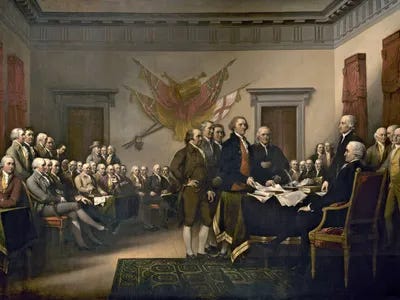
America was born with a warning label.
The Founders understood human nature well enough to know that power corrupts, which is why they spent so much time building a system designed to constrain it — checks and balances, separation of powers, an independent judiciary, a free press. They were not naive men. Many of them had watched up close what unchecked power did to people, to governments, to nations. They built the guardrails because they knew someone would eventually try to rip them out.
Two hundred and fifty years later, someone is.
But before we get there, let’s be honest about something: Washington corruption is not a new story. It is not a Republican story. It is not a Democratic story. It is an American story — a throughline that runs from the earliest days of the republic to the present moment. The names and the scandals change. The impulse never does. What has changed, in the era we are living through now, is the brazenness.
The Original Sins
Even before the ink dried on the Constitution, the machinery of self-dealing was warming up. In the 1790s, Treasury Secretary Alexander Hamilton’s financial policies were accused of benefiting wealthy speculators — including some members of Congress who had advance knowledge of the plans. The whispers of insider advantage are almost as old as the republic itself.
The 19th century was, if anything, worse. The Grant administration was awash in corruption, including the Whiskey Ring — a multistate criminal network in which whiskey distillers, Treasury and Internal Revenue agents, and others manipulated liquor taxes to defraud the federal government of roughly $1.5 million per year by 1873. Grant himself was not corrupt, but his inability to see the rot around him became a defining failure of his presidency.
The Grant era also produced the Crédit Mobilier scandal, in which the owners of the Union Pacific Railroad used a shell company to pay themselves roughly twice the actual cost of constructing the transcontinental railroad — netting a profit of between $33 and $50 million — and distributed company stock to approximately 20 members of Congress to keep investigators at bay. This was not the corruption of small men. This was systemic, coordinated, and protected by the very people elected to prevent it.
The 20th century raised the stakes higher. President Warren Harding’s Secretary of the Interior secretly leased federal Navy oil reserves at Teapot Dome, Wyoming, to private oil interests after receiving hundreds of thousands of dollars in payments, becoming the first Cabinet secretary ever convicted and imprisoned for crimes committed while in office. Harding’s administration also saw the head of the Veterans Bureau convicted of bribery and corruption charges, and his Attorney General forced to resign amid investigation into a bootlegging kickback scheme. An entire administration, rotten to the center.
Then came Watergate — still the gold standard of American political scandal. The scandal involved high-level administration officials subverting the will of Congress, using secret deals to get around congressional limitations, and achieving almost no accountability for the executive actions taken. Nixon’s resignation did not clean the wound. It cauterized it. The infection had already spread.
Congress: The Long Hall of Shame
Congress has never been innocent bystanders in Washington’s corruption story. They have been, in many cases, the main event.
In 2002, James Traficant was expelled from the House after being convicted on 10 felony counts, including taking bribes, filing false tax returns, and racketeering — as well as forcing congressional staff to perform personal chores at his farm and houseboat. He served seven years in federal prison and remained unapologetic to the end.
Jack Abramoff pleaded guilty to fraud, tax evasion, and conspiracy, serving nearly four years in prison. His case exposed the deep-rooted relationship between money, lobbying, and legislative influence in Washington and led to calls for sweeping lobbying reforms — reforms that were partially implemented, then slowly hollowed out.
In 2020, a congressional insider trading scandal emerged involving allegations that multiple U.S. senators violated the STOCK Act by selling stock holdings at the start of the COVID-19 pandemic, just before a market crash, using knowledge gained at a closed Senate briefing. Some were investigated. Few faced meaningful consequences.
New Jersey Senator Bob Menendez was charged with corruption in 2023, accused alongside his wife of accepting gold bars, cash, a luxury vehicle, and other benefits in exchange for using his position as Senate Foreign Relations Committee chairman to benefit foreign governments and private businessmen. He was convicted on all charges and sentenced to 11 years in prison in January 2025.
The pattern across two and a half centuries is consistent: power attracts those who want to use it for personal gain, institutions are slow to respond, accountability is uneven, and the public grows a little more cynical with each cycle.
The New Normal: Trump’s Second Term
Which brings us to where we are.
Every era of American corruption has had its defenders. Every scandal has produced someone to say it was overblown, partisan, or business as usual. And sometimes, they were right. Context matters. Proportion matters. But there is a difference between corruption that operates in the shadows — that at least acknowledges its own illegitimacy by hiding — and corruption that operates in broad daylight, daring you to do something about it.
Donald Trump’s second term has produced the latter kind.
Three days before his inauguration in January 2025, Trump launched the $TRUMP meme coin, a cryptocurrency venture that generated at least $350 million through token sales and fees within weeks of its launch. The timing was not subtle. A president-elect monetizing his brand on the eve of taking office, through a financial instrument with essentially no regulatory oversight, is a conflict of interest so naked it barely requires explanation.
Within hours of launch, the coin surged over 300 percent in value. At least one major trading platform began offering it to retail investors at $74 per token, allowing insiders and early buyers to cash out, dump their holdings, and leave ordinary retail investors holding an asset in freefall. The Trump family and their partners received millions in real dollars while investors absorbed the losses.
A forensic analysis commissioned by the New York Times concluded that over 813,000 wallets lost a combined $2 billion trading the coin, while the president’s company and partners profited approximately $100 million from trading fees alone.
But the meme coin was just the beginning. As of 2025, the Trump family owned four separate cryptocurrency ventures. His World Liberty Financial venture created a stablecoin, USD1, and in May 2025 a UAE-based firm used USD1 to facilitate a $2 billion investment in a crypto exchange — a deal that will generate tens of millions of dollars annually for the Trump family. Two weeks after that deal closed, a UAE sovereign wealth fund entity gained access to hundreds of thousands of advanced American AI computer chips through a White House agreement. The sequence of events was documented. The connection was obvious.
In May 2025, after the $TRUMP coin had lost significant value, the Trump organization announced that top investors in the coin would be invited to a private dinner with the president at Mar-a-Lago, followed by a special White House tour. Thirty-five members of Congress wrote to the Department of Justice demanding an investigation, stating that the arrangement invited foreign influence over U.S. policy and potentially violated the Constitution’s foreign emoluments clause. Anthony Scaramucci, former White House Communications Director, characterized the arrangement as “Idi Amin level corruption.”
A November 2025 report by Democrats on the House Judiciary Committee concluded that Trump’s cryptocurrency policies had been used to benefit Trump and his family directly, adding billions to his net worth through schemes entangled with foreign governments, corporate allies, and criminal actors — and that Trump had simultaneously dismantled anti-corruption and financial integrity safeguards and pardoned individuals described as “corporate cronies” to build his cryptocurrency empire.
The Founding Fathers, who built the emoluments clause specifically because they abhorred the idea of foreign powers corrupting American political leaders, would be confronted today by the spectacle of Russian oligarchs, members of the Saudi royal family, and Chinese Communist Party-linked interests purchasing the president’s cryptocurrency in an effort to influence U.S. policy.
The Difference Between Then and Now
Here is what separates this moment from every prior era of American corruption: it has been stripped of pretense.
The Whiskey Ring hid in coded ledgers. Teapot Dome required a Senate investigation to unearth. Watergate needed a two-year criminal investigation, secret tapes, and a Supreme Court ruling to fully surface. Even the congressmen who traded on COVID intelligence in 2020 at least tried to be discreet about it.
What we have now is a sitting president who launched a personal cryptocurrency three days before taking office, who hosted foreign investors buying that currency at his private club, whose family business has generated billions from dealings with the governments his administration negotiates with — and who publicly dismissed any concern about it.
Trump did not sign the customary ethics pledge upon taking office and has fired many of the officials who monitor ethics, alarming government watchdogs. The referees have been removed from the game.
This is not simply more corruption. It is corruption that has decided it does not need to hide. That distinction matters, because a democracy that cannot name what it is seeing cannot hold it accountable.
What It Actually Costs
The real cost of Washington corruption is not measured in dollars, though the dollars are staggering. It is measured in the slow collapse of public trust — in the creeping sense, now shared across party lines, that the system is not designed to work for ordinary people. That cynicism is the most durable product Washington has ever manufactured.
Two hundred and fifty years of history suggest that American institutions have a capacity for self-correction. Scandals have led to reforms. Reforms have been tested. Some have held. But that resilience has always depended on something basic: the belief that there are rules, that they apply to everyone, and that breaking them carries consequences.
When that belief goes, the corruption does not just persist. It accelerates.
The question for this moment in American history is simple, and it has no partisan answer: Are we a country with laws, or are we a country with powerful people?
Both parties have given us reasons to ask.
Only one, right now, is daring us to find out.