


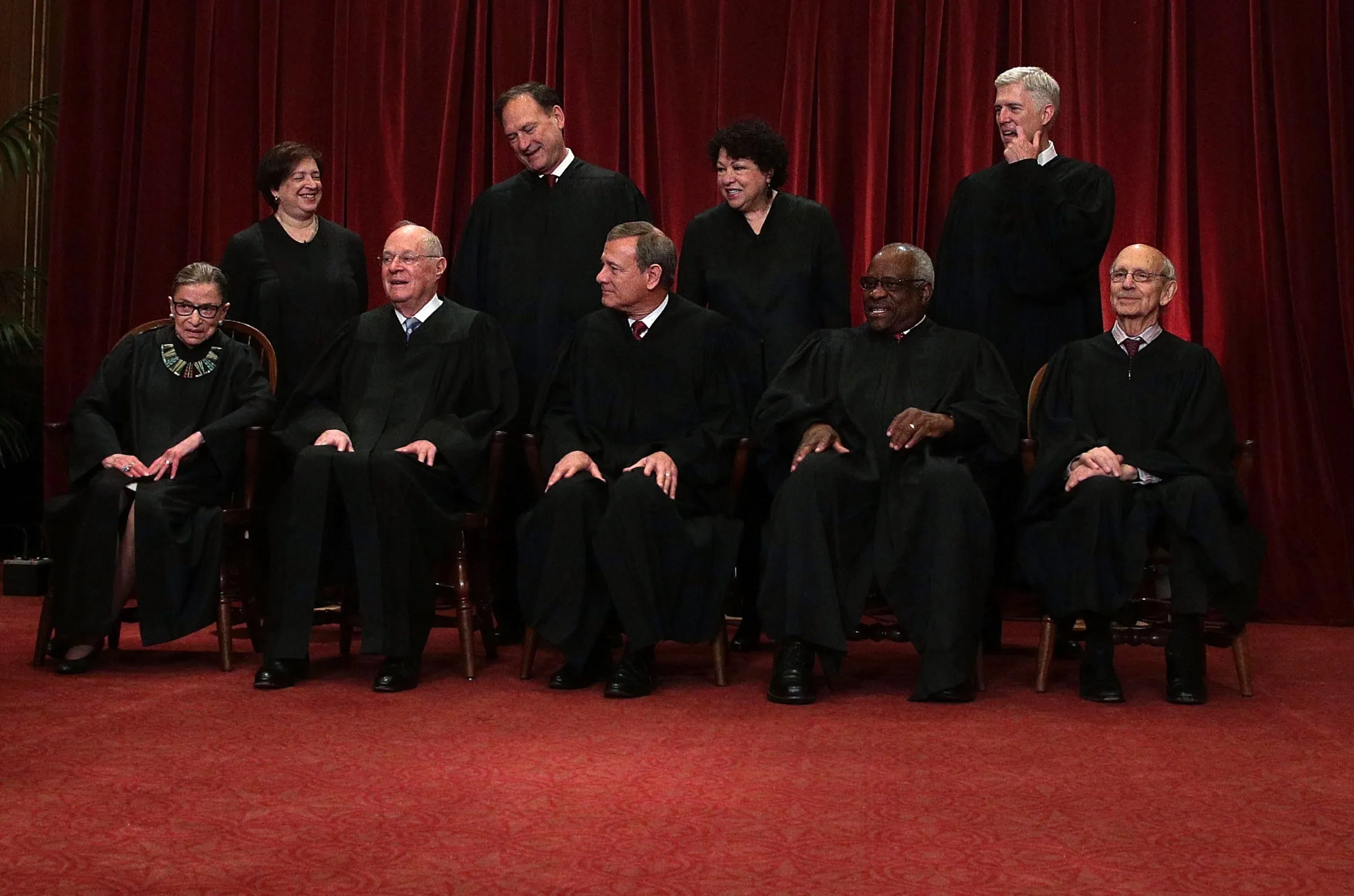
In the span of one week, the Supreme Court of the United States issued a string of immigration decisions that will fundamentally reshape how this country processes, protects, and rejects the people who arrive at its borders. On June 25, 2026, the Court issued two major immigration rulings, each decided 6-3 in the Trump administration’s favor. A third case — one that could alter a constitutional right that has existed for over 150 years — is still pending as of this writing, with a decision expected any day. American Immigration Council
These weren’t close calls. They weren’t narrow procedural rulings buried in legal footnotes. They were sweeping, partisan, ideologically clean votes that followed a predictable pattern: six conservative justices on one side, three liberal justices on the other. If you want to understand what just happened to American immigration law, here’s the breakdown.
Case #1: The End of Temporary Protected Status — Mullin v. Doe
The first ruling involved a program called Temporary Protected Status, or TPS. Most Americans haven’t heard of it, but for roughly 1.3 million people living lawfully in the United States, it was the legal ground they stood on.
TPS is a humanitarian protection granted by the government to nationals of countries experiencing armed conflict, natural disasters, or other extraordinary conditions. It’s not citizenship. It’s not a green card. It is — as the name says — temporary. But for hundreds of thousands of people, “temporary” had stretched into years, even decades, because the conditions in their home countries never stabilized enough to safely return.
When President Trump took office, roughly 1.3 million people were present lawfully in the United States on TPS, including 350,000 Haitians — the majority of whom entered legally during the Biden administration and were granted TPS following the assassination of Haitian President Jovenel Moïse in July 2021 — and 4,000 Syrians. American Immigration Council
The Trump administration moved to end TPS for Haitians and Syrians almost immediately upon taking office. Lower courts blocked those terminations, ruling that the administration had failed to follow required legal procedures. That’s when the case reached the Supreme Court.
The Court ruled 6-3 that a provision of the TPS statute limiting lawsuits challenging TPS “determinations” prevented courts from hearing any lawsuits challenging the Department of Homeland Security secretary’s failure to follow the required legal procedures. In other words, the majority didn’t even decide whether the administration did follow the law. They ruled that courts couldn’t ask the question in the first place. American Immigration Council
That distinction matters enormously. The Court did not rule on whether former DHS Secretary Kristi Noem had gone through the required procedures set out by law. Rather, the Court said that questions of whether the DHS secretary followed the law cannot be heard by courts in the first place, meaning that in the future, even an openly unlawful decision to grant or terminate TPS could be entirely insulated from judicial review. American Immigration Council
Read that again: even an openly unlawful decision could now be unreviewable.
In addition, the majority opinion declared that President Trump’s repeated public denigration of Haiti and Haitians did not rise to the level of unconstitutional racial animus that would permit a court to set aside the TPS decision. American Immigration Council
The White House celebrated immediately. White House spokeswoman Abigail Jackson said the decision was a “tremendous win” and “affirmed what President Trump has always maintained: temporary protected status is, by definition, temporary. It was never intended to be a pathway to permanent status or legal residency.” CNN
The human stakes, however, are enormous. As of today, nearly 300,000 people still retain TPS that has yet to expire or be terminated by the Trump administration, including almost 200,000 Salvadorans who have had TPS for over 25 years and 50,000 Ukrainians who have had TPS since the outbreak of the war. All of them are now exposed. American Immigration Council
Nearly 190,000 Haitian TPS holders were employed in early 2025, according to an analysis by FWD.us, a policy and advocacy organization. Florida has the largest share by far, but tens of thousands also reside in New York, Massachusetts, Pennsylvania, Ohio, and other states. CNN
Case #2: Turning People Away at the Door — Mullin v. Al Otro Lado
The second ruling is, in some ways, even more legally significant — because it doesn’t just affect one group of people. It affects the entire architecture of the American asylum system.
The Supreme Court cleared the way for the Trump administration to potentially revive an immigration policy once used to turn back migrants seeking asylum at the U.S.-Mexico border. The policy limited the number of people who could apply for asylum each day, first under the Obama administration and then expanded during President Donald Trump’s first term. This practice is called “metering.” PBS
Here’s how it worked: immigration officials at official border crossings would physically block asylum seekers from setting foot on American soil — sometimes for days, weeks, or months — forcing them to wait in line in Mexico. Advocates said the tactic created a humanitarian crisis as thousands of people settled in unsafe makeshift shelters to await their turn. The Trump administration said it was necessary to deal with an increase of asylum seekers at the border. PBS
The legal question the Court was asked to answer sounds technical but has massive implications: does a person “arrive in the United States” for the purpose of requesting asylum when they’re still standing in Mexico at a port of entry, or only after they physically cross into U.S. soil?
Justice Alito delivered the opinion of the Court, joined by Chief Justice Roberts and Justices Thomas, Gorsuch, Kavanaugh, and Barrett. The majority held that asylum rights under the Immigration and Nationality Act attach only when a person has actually crossed into the United States — not while standing at the border on Mexican soil. Supreme Court of the United States
Justice Sonia Sotomayor read her dissent from the bench — a step justices reserve for cases of strong disagreement — calling the ruling a “tragedy” that lets the government “slam the door” on people fleeing persecution. She warned that an administration could now insulate itself from asylum claims simply by blocking access to U.S. soil. Open Class Actions
The bench announcement was unusually tense: after Sotomayor finished, Justice Alito delivered a rare unscripted response defending the decision and noting that metering had been used as an operational tool under both Democratic and Republican administrations. That’s technically true — and it’s also one of the few places where a non-partisan lens actually matters here. Both parties helped build the legal scaffolding the Trump administration is now using to its full advantage. Open Class Actions
The Department of Homeland Security did not immediately say whether it plans to revive the metering policy, but applauded the ruling. “This decision opens up an important tool to continue securing our southern border,” said James Percival, the agency’s general counsel. PBS
Kelsi Corkran, Supreme Court Director of the Institute for Constitutional Advocacy and Protection, who argued the case, said: “The ball is now in Congress’s court to enact legislation correcting the Court’s error and ensuring that arriving asylum seekers are not forced back to violent and life-threatening situations.” American Immigration Council
That’s the quiet conclusion buried in the legal language: if Congress doesn’t act, the policy stands. And right now, Congress isn’t acting on much of anything.
Case #3: The Big One Still Coming — Trump v. Barbara and Birthright Citizenship
If you thought last week’s rulings were consequential, wait until you see what’s still in the pipeline.
One of the biggest decisions involves birthright citizenship, which is expected to come down Tuesday. The case, Trump v. Barbara, challenges an executive order President Trump signed on his first day back in office that would effectively end automatic citizenship for children born in the United States to parents who are in the country illegally or on temporary visas. CBS News
Birthright citizenship — the idea that if you are born on American soil, you are an American citizen — has been the law of this land since the 14th Amendment was ratified in 1868. It reflects the principle of jus soli, or right of the soil, extending citizenship purely on the basis of geographic location. It was affirmed by the Supreme Court in 1898 in United States v. Wong Kim Ark, a case where the Court held that a child born in San Francisco to Chinese immigrants was a citizen of the United States. ABC News
The Trump administration’s argument is creative, legally speaking. Rather than trying to overturn Wong Kim Ark directly, the Solicitor General argued that the Citizenship Clause was intended to give birthright citizenship to those newly freed from slavery and their descendants — and was never intended to grant citizenship to “the children of temporary visitors or illegal aliens” because, “unlike the newly freed slaves, those visitors lack direct and immediate allegiance to the United States.” Congress.gov
The government’s theory turns in part on the concept of “domicile” — arguing that a person must have lawful, permanent immigration status for their U.S.-born child to receive citizenship. Justice Barrett pushed back during oral arguments, asking squarely: “How would it work? How would you adjudicate these cases? You’re not going to know at the time of birth for some people whether they have the intent to stay or not — including U.S. citizens, by the way.” Congress.gov
Observers at oral argument noted the Court appeared likely to side against the Trump administration on birthright citizenship. But “appeared likely” is not “decided” — and the Court has surprised observers before, particularly in this term. SCOTUSblog
If the executive order were to take effect, a U.S. birth certificate alone would no longer be sufficient proof of citizenship for any child going forward, including those born to American parents. Immigrant advocates have warned of a “bureaucratic nightmare” for all parents of newborns. ABC News
The practical implications would be staggering. “It’s going to have a huge impact on hospitals,” said immigration attorney Tessy Ortiz. “How are they going to determine who is a citizen and who is not a citizen? This is going to be tough.” CBS News
What You’re Not Hearing
Most of the coverage of these rulings has fallen into a familiar groove: conservatives celebrating border security, progressives mourning humanitarian loss. Both reactions are legitimate. Neither is the complete picture.
Here’s what’s getting less attention.
First, the Court didn’t just rule on the merits of TPS and asylum law. It ruled on who gets to rule. In the TPS case especially, the majority effectively removed a class of executive decisions from judicial oversight altogether. That’s not an immigration ruling — that’s a structural power shift. A future administration of any party will now inherit the precedent that DHS decisions on TPS cannot be challenged in court.
Second, the asylum metering case was correctly noted by Justice Alito — metering didn’t begin with Trump. It began under President Obama. The Trump administration expanded it. The courts stopped it in 2021. Now the Supreme Court has blessed its potential return. This is a bipartisan failure dressed up as a partisan fight.
Third, the human beings at the center of this are real and the numbers are not abstract. Hundreds of thousands of people are now vulnerable to losing work authorization and facing deportation. Families that have been in the United States for over 25 years, contributing to communities, paying taxes, raising American-citizen children, are facing a future that was legally stable one week ago and is now not. American Immigration Council
Fourth — and this is the part both sides don’t want to fully reckon with — Congress could fix most of this. Unless Congress takes steps to provide permanent legal status to TPS holders, hundreds of thousands are now vulnerable. The Supreme Court has not ended the debate on immigration. It has sent it where it constitutionally belongs: back to the legislature. Whether Congress does anything about it is a political question, and the answer right now is almost certainly no. American Immigration Council
The Supreme Court is doing what courts do: interpreting law as it exists. What’s broken isn’t nine justices. What’s broken is a legislative body that has been unable to pass comprehensive immigration reform for more than two decades, leaving the entire system to be built and dismantled by executive action and court decisions, one ruling at a time.
The Bottom Line
Three major immigration cases in one week. A fourth still coming. A 6-3 conservative supermajority willing to hand the executive branch broad new tools to restrict, limit, and terminate protections for migrants at nearly every stage of the process.
Whatever you think about border security, whatever your views on immigration levels or enforcement priorities — the question worth asking right now isn’t which party won or lost this week. The question is: does a system that was built on temporary executive orders and perpetually deferred legislative action actually serve the country?
Because right now, it isn’t serving anyone particularly well. Not the immigrants left in legal limbo. Not the border communities overwhelmed by inconsistent policy. And not the American people, who deserve a real immigration system — not a perpetual political football bounced between courts and executive orders every four years.
The Supreme Court issued its rulings. The ball is in Congress’s court. Don’t hold your breath.