


Welcome to the very first edition of The Sunday Paper.
If you are anything like me, you are probably completely exhausted by the constant, exhausting noise of the 24-hour news cycle. It feels like every time you turn on the TV or open an app, you’re being shouted at, spun, or fed a narrative that feels completely disconnected from the actual lives of everyday people.
That is exactly why we built Average American. We wanted a space to cut through the partisan theater and talk about what is actually happening in our country with some straightforward common sense. Every Sunday morning, our Editor-in-Chief, Kameron Rudat, and I are going to bring you a deeply thoughtful, honest breakdown of the week’s biggest stories. Our goal is simple: to give you the facts you need, share some honest perspectives, and let you get caught up over your morning coffee without the headache.
Let’s dive into what we are tracking this week.
1. The Passing of Senator Lindsey Graham
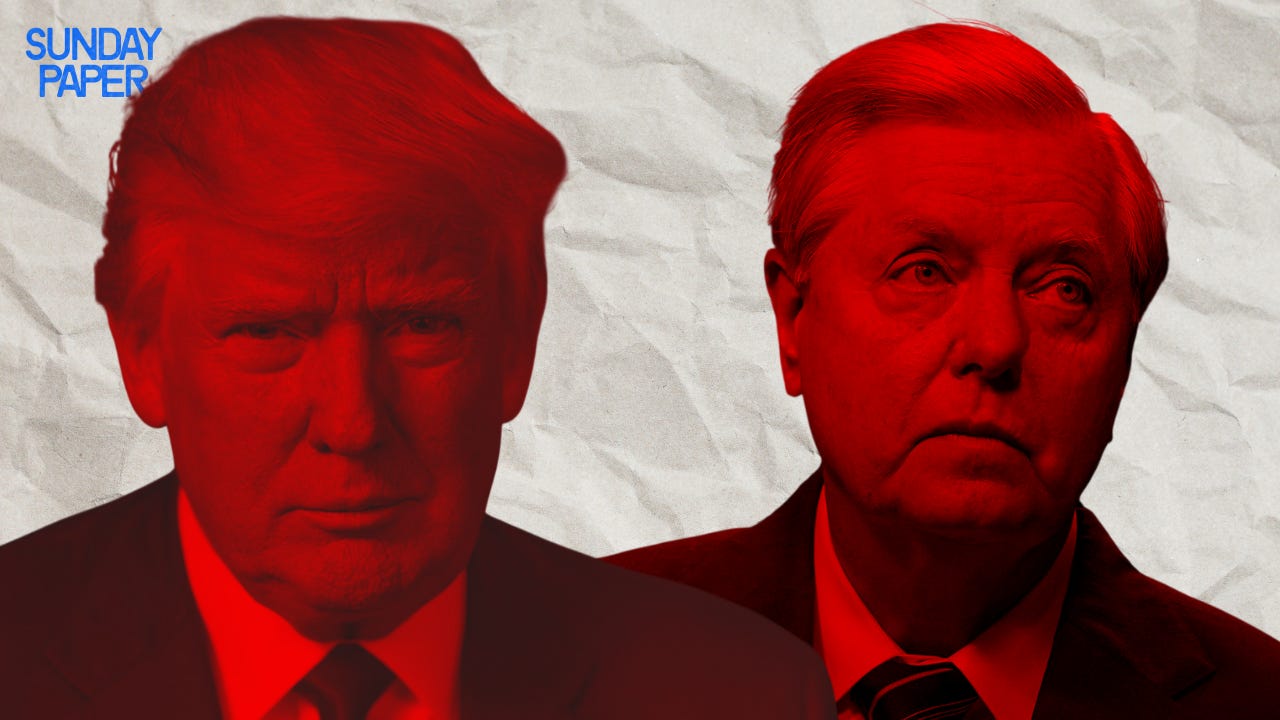
The biggest and most shocking news of the week was the sudden passing of South Carolina Senator Lindsey Graham at age 71. He had just returned to Washington from a high-profile diplomatic visit to Ukraine when he suffered a sudden aortic dissection on Saturday night. It’s an incredibly heavy loss for his family, his loved ones, and the state of South Carolina. His younger sister, Darline Graham Nordone, has been selected to temporarily serve out his immediate term, but with his seat already up for reelection this November, the political landscape in South Carolina is about to become highly competitive.
Earlier this week, I sat down and wrote an in-depth piece for the site reflecting on his legacy. Love him or hate him, Lindsey Graham was an absolute institution in Washington for three decades. He was one of the last of the “three amigos”—alongside John McCain and Joe Lieberman—who defined a highly aggressive, interventionist era of American foreign policy. Graham was a true foreign policy hawk; he believed with every fiber of his being that American military dominance and global intervention were necessary to keep the world stable.
But with his passing, a major question hangs over our government: Will his hawkish views on foreign intervention die with him?
Personally, I think they should.
While I deeply respect his thirty years of public service and his fierce patriotism, my view has always been that the U.S. needs to step back from trying to police the globe. We have massive, undeniable crises right here within our own borders—from a strained economy to crumbling infrastructure and a dividing social fabric. These domestic challenges require our full attention, our resources, and our leadership. It is time to wind down these endless foreign entanglements, and I hope Senator Graham’s passing marks a moment where Washington finally pauses to reassess our global posture.
2. A War in Our Pockets: The Escalating Conflict with Iran
Speaking of foreign conflicts, the situation in the Middle East is rapidly spiraling out of control. The tentative ceasefire has completely collapsed, and we have now witnessed six consecutive nights of major U.S. airstrikes targeting Iranian infrastructure, ports, and military bases. In response, Iran has launched retaliatory drone and ballistic missile strikes against U.S. assets and regional allies. It is a highly volatile, dangerous situation.
Let’s look at this neutrally. On one hand, you have the argument for national security and global trade. The Strait of Hormuz is one of the most critical energy choke points on earth, and keeping commercial shipping lanes open is a massive priority for global commerce.
On the other hand, the reality for the average American is that these conflicts never stay overseas—they hit us directly in our everyday lives. Energy analysts are already sounding the alarm about global energy security, and we are starting to see the threat of skyrocketing fuel costs, shipping disruptions, and further inflation on the horizon. The working-class families of this country are the ones who ultimately pay the price for these conflicts, whether at the gas pump, the grocery store, or through the lives of our service members.
In my opinion, we simply cannot afford to get dragged into another open-ended conflict in the Middle East. It needs to end, and it needs to end right now. The primary responsibility of the American government should always be the safety, security, and economic stability of the people living right here on our own soil. It’s time to bring the focus back home.
3. The Right Way to Handle Election Integrity
Lastly, we saw a massive wave of headlines following President Trump’s address from the East Room, where he released redacted classified information regarding foreign adversaries targeting voter data.
Let’s be entirely clear about this: election integrity is not a partisan issue. It is the absolute bedrock of our republic. If the average citizen cannot trust that their vote is secure, accurate, and fairly counted, the entire foundation of our democratic system falls apart. We absolutely need to secure our elections.
But we have to handle this the correct way.
Too often, “election integrity” is used as a political football. It gets hijacked for partisan theater, finger-pointing, and fundraising emails designed to make people angry and distrustful. That is the wrong way.
The correct way is focusing on transparent, common-sense measures that protect the vote without making it a circus. We need secure, uniform voter ID laws. We need robust, transparent auditing systems that both parties can observe and trust. And we need a serious, non-partisan upgrade to our cyber security to keep foreign adversaries completely out of our voter infrastructure. We need to secure the vote so that every American—regardless of who they vote for—can look at an election result and have total confidence in the outcome.
Columnist Corner
Before you close this email and enjoy the rest of your weekend, I highly encourage you to head over to our Substack homepage. Our columnists have put out some incredible, deeply grounded pieces this week covering everything from local economic resilience to culture stories that the mainstream networks completely overlooked.
We are building something incredibly special here at Average American, and we couldn’t do it without your support.
Grab another cup of coffee, enjoy your Sunday with your family, and we will see you in your inbox next week.
Best,
Kameron Rudat
Founder, Average American