


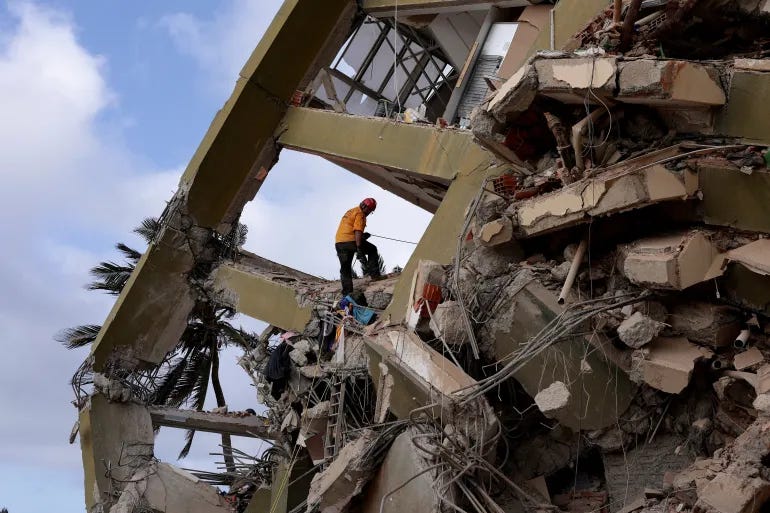
A Nation Already on Its Knees, Shaken Again
On the evening of June 24, 2026, the ground beneath northern Venezuela tore itself apart twice in less than a minute. A magnitude 7.2 foreshock struck near the town of Yumare in Yaracuy state at 6:04 p.m. local time. Thirty-nine seconds later, a far more powerful magnitude 7.5 mainshock ruptured along the same fault zone. Seismologists would later describe it as a doublet event — two massive earthquakes so close together in time and space that they functioned almost as one continuous catastrophe. Some observatories, picking up a complex, two-minute-long seismic signature, classified it as a single magnitude 7.8 event. However the instruments measured it, the people of Caracas, La Guaira, and the surrounding coastal states felt only one thing: the earth giving way beneath an entire country that had already spent a decade in crisis.
What followed has become the deadliest natural disaster to strike Venezuela in more than a century. As of this week, confirmed deaths have climbed past 1,700, with thousands more injured and an unknown number still missing beneath collapsed apartment towers, government buildings, and informal housing built into hillsides never engineered to withstand this kind of shaking. Early modeling from the U.S. Geological Survey’s PAGER system — a tool designed to give rapid estimates of fatalities and economic losses after major quakes — warned that the final toll could climb dramatically higher given the country’s fragile infrastructure and limited capacity to respond.
This is the story of how it happened, why it was so destructive, and what it reveals about a country that was already buckling long before the ground moved.
The Geology Beneath the Headlines
To understand why this earthquake was so devastating, it helps to understand what’s actually happening underneath Venezuela. The northern edge of the country sits inside a wide, complicated boundary zone where the Caribbean tectonic plate grinds against the South American plate. Unlike a single, clean fault line, this is a sprawling network of fractures collectively known as the Boconó–San Sebastián–El Pilar fault system, stretching more than 1,300 kilometers from the Venezuelan Andes all the way to the island of Trinidad. The plates here aren’t colliding head-on; they’re sliding past one another in a right-lateral strike-slip motion, at a rate of roughly 10 millimeters a year — slow by human standards, but more than enough to store up centuries of unreleased stress.
Geologists had flagged this stretch of coastline as overdue for a major rupture. The Boconó Fault, which last broke loose in a catastrophic 1812 earthquake, was understood to have accumulated enough strain to produce something in the magnitude 7.0 to 7.6 range. Separately, researchers including a geophysicist at Florida International University had pointed specifically to the San Sebastián Fault — much of it running offshore just north of Venezuela’s coastal mountain range — as capable of generating a quake around magnitude 7.1. When the doublet hit on June 24, the USGS traced the rupture to a roughly 150-by-20-kilometer patch along exactly that structure, with the mainshock’s epicenter in the Yumare–Morón area, about 100 miles west of Caracas.
In plain terms: this wasn’t a freak accident. It was a long-anticipated release of pressure that had been building since before the country’s last truly comparable disaster — a 1900 earthquake northeast of Caracas that, until June 24, held the record as Venezuela’s strongest in 126 years.
Wednesday Night: When the Shaking Began
The mainshock arrived without meaningful warning, as large strike-slip earthquakes generally do. Within seconds, multi-story buildings in Caracas and the nearby port city of La Guaira began to fail. Apartment blocks in neighborhoods like Catia La Mar, Altamira, and Los Palos Grandes pancaked floor onto floor. In Chacao, a municipality inside greater Caracas, the Petunia residential building collapsed entirely, trapping residents inside — among them an elderly woman’s neighbors who would spend the following days being pulled, piece by piece, from the wreckage.
The coastal town of Morón, close to the quake’s epicenter, was particularly hard-hit, with images circulating of children picking through rubble in the immediate aftermath. Caraballeda, in La Guaira state, saw entire coastal blocks reduced to twisted rebar and concrete slabs. Venezuela’s main international airport sustained structural damage to its terminal roof and was forced to close, complicating the very relief efforts the country urgently needed.
More than 430 aftershocks have rattled the region in the days since the initial doublet — a relentless aftershock sequence that has kept already-traumatized residents from feeling safe returning to homes that may still be structurally compromised, even those left standing.
The Toll, and Why It Keeps Rising
In the first hours after the quake, Venezuelan officials offered cautious, fragmentary numbers. By Thursday evening, the health minister reported a toll of around 235 dead. Within 48 hours, that figure had quadrupled: Venezuela’s National Assembly president announced Friday that the death toll had reached 920, with more than 3,360 injured and hundreds of homes destroyed or seriously damaged. By Monday, June 29, the confirmed death toll had surged past 1,700, with more than 2,150 to upwards of 3,150 injured depending on the source and the moment the count was taken, and tens of thousands reported missing or unaccounted for in the disaster’s chaotic early days.
The gap between those figures isn’t simply sloppy reporting — it reflects the genuine difficulty of counting casualties in a country where communications infrastructure, government transparency, and emergency coordination were all compromised well before the earthquake struck. Search-and-rescue crews are still working through the “golden window,” the critical early days after a structural collapse when survivors trapped in voids have the best odds of being found alive. That window has already produced its share of near-miraculous stories — an infant pulled from rubble, a woman rescued after more than three days trapped beneath a collapsed building — moments of genuine relief threaded through an otherwise grim recovery effort.
But every rescue worker on the ground knows the math gets worse, not better, with time. The USGS’s own predictive modeling has warned that, given the scale of destruction and Venezuela’s limited capacity to mount a fast, well-resourced response, the eventual death toll could climb to a scale far beyond what’s currently confirmed.
A Country That Was Already Breaking
It would be a mistake to read this disaster purely as a geological event. Venezuela was not a stable, well-resourced nation that simply had the bad luck of sitting on an active fault line. It was a country already gutted by more than a decade of economic collapse, hyperinflation, mass emigration, and political upheaval — and that context shapes nearly everything about how this disaster has unfolded.
The earthquake struck against an extraordinary political backdrop. Former president Nicolás Maduro was removed from power and taken into U.S. custody in a January operation, a seismic political event in its own right that left interim leadership, under acting president Delcy Rodríguez, still finding its footing when the literal ground gave way five months later. That transitional government inherited a state apparatus already stretched to its breaking point: a healthcare system short on basic equipment and medication, a power grid prone to extended outages, and public services that had been deteriorating for years.
Those preexisting weaknesses turned what might have been a serious but manageable disaster in a wealthier, better-governed country into a humanitarian catastrophe. Hospitals overwhelmed with thousands of injured patients were already operating with chronic shortages. Emergency responders arrived at collapse sites without enough heavy equipment to safely clear debris, forcing ordinary citizens — neighbors, relatives, volunteers — to dig through rubble with shovels, pickaxes, and their bare hands. One volunteer, describing the scene in a hard-hit neighborhood, said simply that it left him too shocked to even think about documenting what he was seeing. Residents in some areas reported that aid and equipment were unevenly distributed, with certain sites overwhelmed by volunteers while others sat dangerously under-resourced.
There’s also a darker undercurrent. With displaced families forced from damaged homes into makeshift camps and tents, some residents have described fear of opportunistic crime in abandoned neighborhoods — one mother recounting how her partner urged the family to shelter in a public park specifically because their own street had become unsafe once people fled. Disasters expose a society’s seams, and Venezuela’s were already showing.
A Press Blackout in the Middle of a Crisis
One of the more troubling threads running through the disaster response involves information itself. Venezuela has long had one of the most restricted media environments in the world, and that didn’t change simply because a catastrophic earthquake struck. More than 200 websites remain blocked inside the country, including major domestic and international news outlets, social media platforms, and the VPN tools many Venezuelans had used to get around censorship.
That has made it extraordinarily difficult — both for residents inside the country and for family members abroad — to get reliable, real-time information about damage, casualties, and where help is actually needed. A partial easing of restrictions on access to X came only after the United Nations’ Independent International Fact-Finding Mission on Venezuela explicitly called on authorities to fully restore access to social media and news outlets, arguing that timely information access was essential to protecting lives during the emergency itself.
It’s a stark reminder that infrastructure failure during a disaster isn’t limited to roads, hospitals, and buildings. Information infrastructure matters too — and when a government already inclined toward information control faces a crisis that exposes its own failures, the instinct to restrict rather than open up can cost lives.
The World Responds — Awkwardly, but Substantially
The international response has been notable both for its scale and for the diplomatic complexity surrounding it. The United States, despite the recent and still-tense history between Washington and Caracas following the operation that removed Maduro from power, moved quickly to offer assistance. U.S. Southern Command, which oversees American military activity across Latin America and the Caribbean, announced it was surging assigned forces into the region, including the amphibious transport ship USS Fort Lauderdale and the littoral combat ship USS Billings, along with C-17 and C-130 transport aircraft, reconnaissance assets, and rotary-wing support. American rescue crews from Virginia and California deployed alongside aerial imagery teams tasked with assessing damage in remote coastal areas inaccessible by road. Secretary of State Marco Rubio said the immediate U.S. priority remained search and rescue.
The optics of American forces meeting directly with Venezuela’s interim government — including a documented meeting between a U.S. Southern Command general, the American chargé d’affaires, and acting president Delcy Rodríguez — underscored just how dramatically the relationship between the two countries has shifted in a matter of months. A bilateral relationship defined for years by sanctions, hostility, and the eventual removal of a sitting head of state was, within the same year, coordinating disaster logistics on the ground.
The U.S. wasn’t alone. Countries with their own deep experience managing major seismic events — Mexico, Chile, and El Salvador among them — dispatched emergency response teams and medical supplies. The Venezuelan diaspora, scattered across the United States, Colombia, Spain, and beyond, organized supply drives and fundraising efforts for relief on the ground. Even the world of sports paused to acknowledge the scale of loss: FIFA held moments of silence honoring earthquake victims during 2026 World Cup matches played on June 26 and 27, and Major League Baseball, with its long and deep ties to Venezuelan players and communities, organized its own tributes and relief contributions.
Social media played its own complicated role. Venezuelan-American influencer Lele Pons, with tens of millions of followers, used her platform to direct attention and resources toward specific neighborhoods in need, asking followers to flag locations requiring immediate assistance — a small but telling example of how disaster response in 2026 increasingly runs through informal, platform-driven channels as much as official ones, especially in a country where official channels are themselves compromised.
The Economic Aftershock
Earthquakes don’t just kill and displace people — they detonate economies, and Venezuela’s was already among the most fragile in the hemisphere before June 24. Years of hyperinflation, a collapsed oil sector that once formed the backbone of the national budget, and a mass exodus of an estimated several million Venezuelans seeking work abroad had already hollowed out the country’s capacity to absorb a shock of this size. Now add the direct costs: collapsed housing stock that will need to be rebuilt from the ground up, a damaged international airport that complicates both imports of relief supplies and any hope of near-term tourism or trade recovery, and a healthcare system that was underfunded even before it was asked to treat thousands of earthquake injuries on top of its existing caseload.
The interim government under Delcy Rodríguez had only just begun signaling an intent to stabilize and grow the economy when the disaster hit, and officials have been candid that recovery will require outside financial and technical assistance the country cannot generate on its own. That reality places Venezuela in an unusual position: a nation that spent years isolated by sanctions and diplomatic estrangement from much of the Western world now needs exactly the kind of sustained, large-scale international investment that estrangement was designed to prevent. How quickly — and on what terms — that assistance materializes will likely shape the country’s trajectory for years, independent of the earthquake itself.
Echoes of 1812, and the Question of What Comes Next
Venezuelans old enough to know their history will recognize the shadow this disaster casts. The devastating 1812 Caracas earthquake, which struck during the country’s war for independence, is remembered as one of the deadliest events in the nation’s history — and notably, modern seismologists believe it may itself have involved at least two large subevents, much like the 2026 doublet. The 1900 quake northeast of Caracas, magnitude 7.7, held the record for Venezuela’s strongest earthquake for over a century until last week. And the 1967 Caracas earthquake, which killed more than 200 people, remains the most recent disaster of comparable scale before this one — meaning an entire generation of Venezuelans has now lived through the worst seismic event of their lifetimes.
What distinguishes 2026 isn’t just the magnitude of the shaking — it’s the magnitude of the country’s vulnerability when it struck. A wealthier nation with stronger building codes, better-funded emergency services, and a functioning information ecosystem would still have suffered real losses from a doublet this size. Venezuela, arriving at this moment after years of economic freefall, mass emigration of skilled workers, and institutional erosion, had almost none of the buffers that might have softened the blow.
The recovery ahead will be measured in years, not weeks. Health officials have already characterized rebuilding as a long-term effort requiring sustained financial and technical support from outside the country — support that will need to navigate a still-evolving political relationship between Venezuela’s interim government and the international community, the United States chief among them. Hundreds of thousands of people remain displaced, sheltering in parks, churches, and informal camps as aftershocks continue to rattle a population already running on empathy fumes.
For now, the work is simpler and more urgent than questions of policy or geopolitics: clearing rubble, searching for survivors, burying the dead, and trying to keep families fed and sheltered while a battered government and an improvised coalition of international partners figure out what rebuilding a nation actually looks like when the nation in question was already running on empty before the ground ever moved.
This is a developing story. Casualty figures, displacement numbers, and details of the international response are continuing to change rapidly as rescue and recovery operations proceed.