


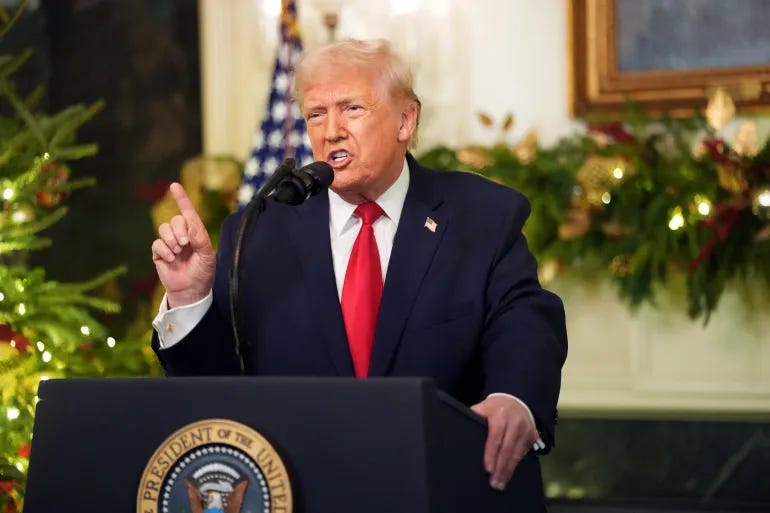
Okay, so last night President Trump did something he doesn’t do very often — he gave a primetime address from the White House. Not a rally, not a press gaggle, not a late-night tweet storm. A full, scheduled, “clear your evening and turn on the TV” address from the East Room. That alone should tell you something. Presidents don’t burn a primetime slot unless they think what they’re saying is a big enough deal to interrupt everybody’s dinner.
So let’s talk about what actually happened, what he actually said, and then — because you know I’m not going to just report the news and walk away — let’s talk about the part of this whole election integrity fight that I think everybody keeps getting wrong: voter ID.
What Actually Happened Thursday Night
Trump spoke for about 25 minutes from the East Room. The official framing going in, from Press Secretary Karoline Leavitt, was that he’d be presenting “findings” on election integrity that would “shock” anyone listening with an honest ear. That’s a bold promise to make before your boss even opens his mouth.
Here’s the headline: Trump announced the declassification and immediate release of a batch of intelligence documents that he says were compiled by something called the White House Government Transparency Task Force, working alongside the President’s Intelligence Advisory Board and reviewed by top intelligence agency chiefs. The centerpiece claim is a big one — Trump alleged that starting back in 2020, China carried out what he called the largest compromise of election data in American history, resulting in the acquisition of roughly 220 million U.S. voter files. We’re talking names, addresses, phone numbers, party registration — basically everything you’d need to build a very detailed picture of the American electorate, and potentially everything you’d need to start targeting specific voters.
He broke the documents down into what he described as five major areas of concern, all falling under the broader umbrella of election security. He also claimed that China’s motivation went beyond just data collection — that Beijing specifically wanted him to lose the 2020 election because, in his words, they knew he was “wise to them.” That’s a much more direct and personal claim than “a foreign power tried to gather data.” That’s “a foreign power tried to beat me because I was a threat to them.”
On the action side, Trump said he’s directing the Department of Homeland Security to notify every state about noncitizens allegedly sitting on their voter rolls and to get them removed before the midterms. He’s also asking the CIA, DOJ, and FBI to investigate how this alleged Chinese data compromise was supposedly buried for years, and by whom. That’s a serious ask — that’s essentially alleging a cover-up inside the federal government that spans two administrations, his own first term included.
And of course, he used the moment to push, once again, for Congress to pass the SAVE Act.
Now Here’s the Part Where I Put My “What They’re Not Telling You” Hat On
A few things are true at the same time here, and cable news on both sides is going to have a hard time holding all of them in their heads at once, so let me try.
First: it is true that the U.S. intelligence community, under both the Trump administration and the Biden administration, reviewed the 2020 election and did not find credible evidence that any foreign government altered votes or compromised the actual integrity of the outcome. That’s not a partisan talking point — that’s the conclusion of a declassified intelligence assessment from back in March 2021, produced under Trump’s own director of national intelligence. So when people push back on “the election was stolen,” they’re not making that up out of thin air. That conclusion exists, in writing, from his own administration.
Second: it is also true that data compromise and vote tampering are two completely different things, and a lot of the coverage last night — on both sides — blurred that line on purpose because it serves the narrative they want to push. A hostile actor stealing 220 million voter files (if that claim holds up under scrutiny) is a real and serious cybersecurity problem. It is not, by itself, evidence that any vote was actually changed. Trump’s own speech, according to multiple outlets that reviewed it, didn’t actually claim a single vote was proven fraudulent. He talked about “vulnerabilities,” not “stolen votes.” That’s a meaningfully different claim than what he’s made in years past, and it’s worth noting he didn’t repeat his usual “I actually won” line last night either.
Third: the timing here is not an accident, and I think you’d be naive to pretend otherwise. This comes as his approval ratings are sitting near second-term lows, as the war involving Iran creeps toward the five-month mark, and as some Republicans on the Hill are publicly saying they’d rather he focus on the economy right now. Democratic critics, including Senator Chris Coons, called the speech a “temper tantrum” over Congress not passing the SAVE Act. Senate Minority Leader Chuck Schumer went further, framing the whole thing as an attempt to lay groundwork to delegitimize the 2026 midterms before a single vote is cast. All 24 Democratic governors put out a joint statement afterward accusing the administration of trying to intimidate and silence voters.
On the flip side, you had people like Steve Bannon calling the speech “incredibly powerful” and immediately using it to argue we need a “national security emergency” declared around the midterms — which is a genuinely wild leap from “here are some cybersecurity vulnerabilities” to “we might need emergency powers over an election,” and it’s worth pointing out that leap directly contradicts what Trump himself said the speech was supposed to be about. He explicitly said the release wasn’t meant to “weaken confidence” in U.S. elections. So even people in his own corner are already using this to do the exact thing he said he wasn’t trying to do. That’s the kind of gap between “what the guy actually said” and “what people immediately do with it” that this newsletter exists to point out.
So here’s my honest read: the underlying cybersecurity claims deserve real scrutiny and real reporting, not immediate dismissal just because of who’s making them and not immediate acceptance just because a document got stamped “declassified.” China has denied the allegations, as they always do. We should wait to see the actual documents get independently reviewed by people who don’t have a political horse in this race before we treat “220 million voter files” as settled fact. But we also shouldn’t pretend that voter data security is a fake issue just because Trump is the one raising it this time.
Okay, Now Let’s Actually Talk About the SAVE Act — Because This Is Where It Gets Personal for Me
The SAVE Act is the legislation Trump keeps hammering Congress to pass, and it’s been stalled in the Senate for months now. At its core, it would require Americans to provide documentary proof of citizenship when registering to vote, and require some form of ID when actually voting.
And look, I’m going to be straight with you about where I land on this, because that’s the whole point of this publication — I’d rather tell you where I stand and let you push back than pretend I don’t have a view.
I think we need voter ID. I don’t think that’s a radical or extreme position, and frankly, polling has shown for years that a large majority of Americans across party lines support some form of ID requirement to vote. Most Americans already show ID to buy a beer, board a plane, pick up a prescription, or open a bank account. The idea that verifying identity at the ballot box is somehow uniquely oppressive doesn’t match how the rest of our daily lives already work.
But here’s my actual issue with how this fight plays out every single time it comes up: there is so much fake news and bad-faith noise flying around the SAVE Act specifically that the actual substance of the bill gets buried under outrage bait within about 48 hours. And I think both sides do this, but I want to focus on one specific claim that keeps getting used as a cudgel against the entire idea of ID requirements, because I think it’s the most emotionally effective one and also the most fixable one.
You’ve probably seen the argument, especially from further-left commentators: that a proof-of-citizenship or ID requirement would disenfranchise millions of married women because their current legal name, the one on their driver’s license, doesn’t match the name on their birth certificate anymore after they took their husband’s last name. And to be fair to that argument — it’s not made up out of nowhere. There’s real reporting, including from outlets like NPR, pointing out that a meaningful number of citizens genuinely don’t have easy, immediate access to a birth certificate that matches their current legal name, and that this disproportionately affects married women. That’s a legitimate logistical problem, and pretending it doesn’t exist just because you support the broader idea of voter ID is not honest, and it’s not going to convince anybody who isn’t already on your side.
But here’s the thing — and this is where I think the “further left” version of this argument goes off the rails — this is a solvable administrative problem, not a reason to abandon ID requirements altogether. It’s not actually an argument against voter ID. It’s an argument for building one specific, obvious accommodation into the process.
If a woman’s ID doesn’t match her birth certificate because she changed her name at marriage, the fix isn’t “throw out the whole concept of verifying who’s voting.” The fix is: bring your marriage license. That’s it. A marriage license is a government-issued legal document that creates a direct, verifiable paper trail connecting the name on your birth certificate to the name on your current ID. It closes the exact gap that critics are pointing at. States that require proof of citizenship or ID for voting should explicitly build in a provision — in plain language, printed right on the registration materials — that says something like: “If your current legal name differs from your birth certificate due to marriage, divorce, or other legal name change, you may present your marriage certificate, divorce decree, or court order as supplemental documentation.” Some states that already have proof-of-citizenship requirements actually do allow exactly this. The problem is that it’s not consistent, it’s not well publicized, and it becomes very easy for opponents of any ID law to act like the accommodation simply doesn’t exist or can’t exist, because acknowledging it undercuts the “this will disenfranchise women” talking point.
That’s the “what they’re not telling you” part of this whole debate. The loudest voices on both sides need the SAVE Act fight to stay simple, because simple is what drives clicks and donations. The left needs it to sound like “Republicans want to strip your grandmother’s voting rights because she took her husband’s name in 1974.” The right needs it to sound like “anyone against this bill wants illegal votes.” Neither of those is the honest, boring, actual truth, which is: yes, verify who’s voting, and yes, build reasonable, well-publicized accommodations for the predictable edge cases like name changes, so you’re not accidentally locking out legitimate citizens over paperwork instead of actually protecting the integrity of the vote.
I’d also add — and this goes for lawmakers on the Republican side pushing this bill — if you want the SAVE Act to actually pass and actually survive the inevitable legal challenges, you need to write these accommodations into the bill text itself, loudly, upfront, not leave them to be worked out state-by-state after the fact or clarified in some FAQ nobody reads. Give the marriage license and legal name-change documentation solution its own explicit line in the statute. Don’t let it be the thing your opponents get to define for you in a viral TikTok before you’ve even had the chance to explain it yourself.
Where This Leaves Us
So where does that leave the average American trying to make sense of all this? Probably somewhere uncomfortable for people who like their politics tidy. The election data security concerns Trump raised last night deserve real, independent scrutiny before anyone treats them as gospel — and given his track record on 2020 claims specifically, a healthy amount of skepticism is earned, not partisan. At the same time, the broader push for voter ID isn’t some fringe authoritarian scheme, and dismissing it wholesale because of who’s currently championing it, or because of a solvable documentation gap, doesn’t actually protect anyone — it just guarantees the fight repeats itself every election cycle with nothing fixed.
We’ll be watching to see what’s actually in those declassified documents once people who don’t have a stake in spinning them for TV get a chance to dig in, and we’ll be watching what, if anything, the SAVE Act actually says about accommodations like this the next time it comes up for a vote. That’s the story worth following here — not the primetime theater of it, but whether anyone in Washington is actually interested in solving the boring, fixable parts of this problem instead of just fundraising off the outrage.